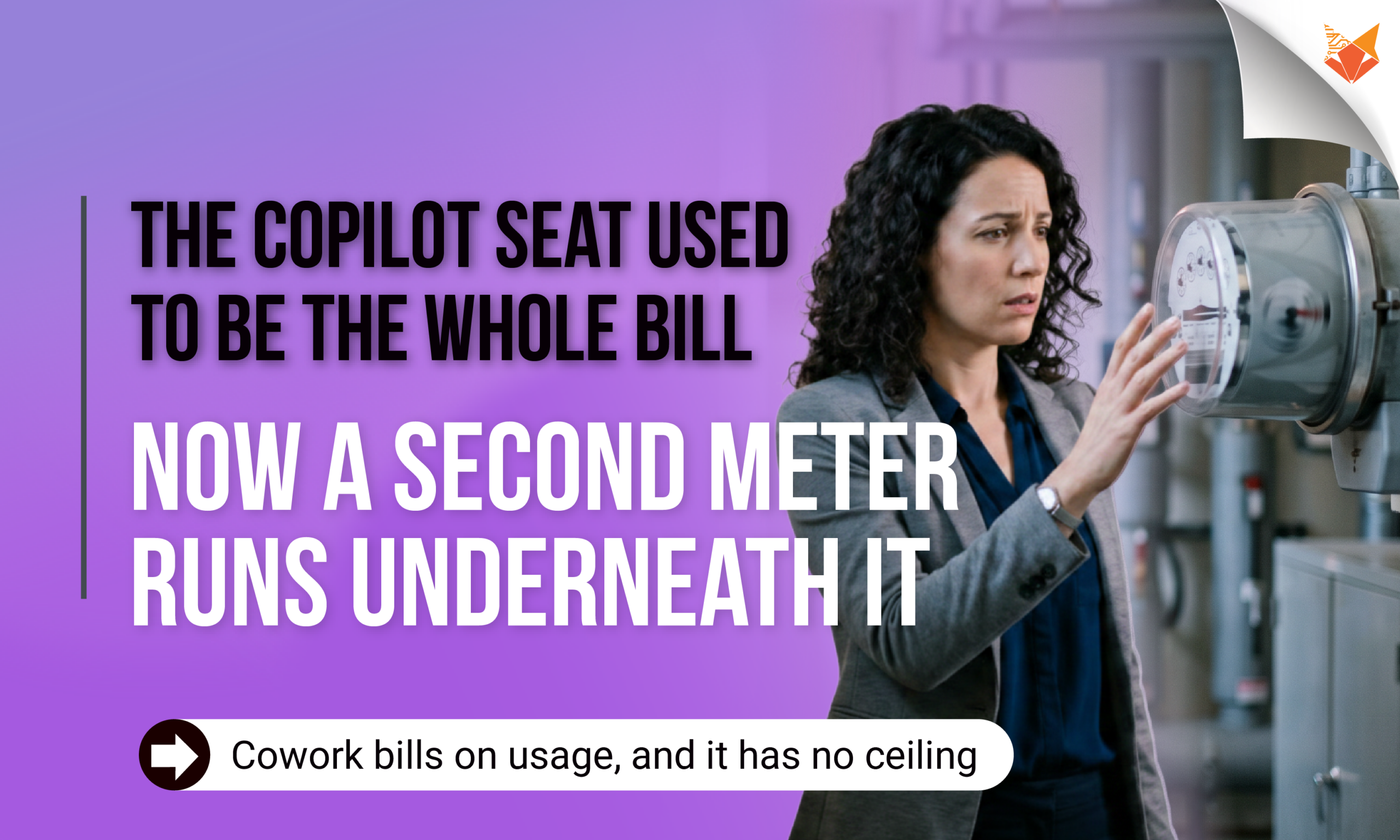
A Microsoft 365 Copilot seat used to be the whole bill. With Cowork, the seat is just the entry fee, and the meter that actually runs is harder to see, predict, or control.
At a Glance

1. The Fourth Meter Has Arrived
For most of the Microsoft 365 Copilot era, cost governance meant one thing: counting seats. A licence cost a fixed amount per user per month, and the entire forecasting exercise was a multiplication. Copilot Cowork billing, generally available since 16 June 2026, does not change the seat price. It adds a second bill on top of it, and that second bill is not fixed.
Every Cowork task is billed in Copilot Credits, and the price of a single task is set by four separate inputs: which model handled it, how much context it pulled in, how many tools it called along the way, and how long it ran. Pay-as-you-go pricing works out to $0.01 per credit, with volume commitments available for a discount. Multiply a seat cost. That part of the bill is now genuinely variable, and it moves with usage patterns that finance teams have never had to model before.
Call it the fourth meter. Storage has a meter. Licence assignment has a meter. Now agent execution has one too, and unlike the other two, it can run unattended for hours across multiple tools without anyone watching the dial.
2. Why Consumption Billing Breaks the Old Cost Model
Seat-based licensing has a property that finance teams quietly relied on: it is self-limiting. Even an unused licence only costs what the licence costs. Consumption billing has no such ceiling. A single agent task that pulls in a large amount of context, calls several tools, and runs for an extended period can cost meaningfully more than a simple one, and from the outside, both look like “a Cowork task ran.”
This is precisely the dynamic that has driven analyst caution around agentic AI spend. Gartner has warned that a large share, by some estimates more than 40%, of agentic AI projects will be cancelled by 2027, and cost overruns alongside unclear return on investment sit near the top of the reasons cited. Forrester has flagged a similar pattern in enterprise pilots: agentic tools that looked cheap in a proof of concept got expensive fast once usage scaled past the controlled pilot group, because nobody had built the cost guardrails before scaling, only after.
None of this means consumption billing is a mistake. It is the only pricing model that makes sense for work that varies as wildly as agent tasks do. It does mean that the old habit, setting the budget once a year and reviewing usage once a quarter, will not catch a runaway pattern before it shows up on an invoice.
A licence sprawl problem and a fourth-meter problem look identical from the IT seat: cost that grows quietly until someone finally checks, by which point the fix is a clean-up project instead of a five-minute adjustment.
3. The Governance Parallel Nobody Is Drawing
Strip away the AI framing, and Copilot Cowork billing model is solving the same underlying problem that Microsoft 365 licensing has had for a decade: a resource gets consumed continuously, by accounts that multiply faster than anyone is reviewing them, and the only way to control the cost is to control the consumption at the source.
The parallels run deeper than pricing mechanics. Licence sprawl happens because nobody right-sizes assignments after the initial rollout; unused or oversized licences sit there costing money until someone audits them. Agent cost sprawl will happen the same way: nobody right-sizes which tasks actually need the most capable model, the widest context window, or the longest runtime, so the default settings quietly become the expensive settings for every task, including the simple ones.
Permissions hygiene is the second parallel, and arguably the more urgent one. An agent task does not just cost credits; it acts with whatever access the account running it already has. A Cowork task triggered by an account with stale permissions to a large SharePoint site does not just risk seeing data it should not see, it also risks pulling that entire site into its context window, which is one of the four inputs that set the price. Bad permissions hygiene does not just create exposure. Under consumption billing Microsoft 365, it creates cost.
Lifecycle management is the third. Microsoft’s own Entra ID team has been pushing organisations for over a year to treat service accounts and non-human identities with the same lifecycle discipline as human ones, because an orphaned service identity that nobody decommissioned is both a security gap and, increasingly, a cost centre. Identity security researchers now estimate non-human identities outnumber human ones by something in the order of 10 to 1 across typical enterprise tenants. Agents are the newest, fastest-growing category in that count, and most organisations have no equivalent of an offboarding checklist for an agent task that nobody remembers commissioning.
Power Platform governance teams learned this lesson years before agents existed. A maker builds a flow, the flow keeps running long after the maker has left the team or the project has wound down, and the licence or connector cost attached to it keeps accruing until someone goes looking. The fix that emerged for Power Platform, centre-of-excellence visibility into every flow and its owner, is the same fix AI cost governance agent will need: not a one-time cap, but continuous tenant-wide visibility into what is running, who owns it, and what it is costing right now, not what it cost last quarter.
4. What Analysts and Regulators Are Already Watching
The cost governance conversation is not happening in isolation from the security one. ENISA and CISA have both flagged unmanaged machine and agent identities as an expanding attack surface through 2025 and into 2026, for the same structural reason finance teams should care: an identity nobody is tracking is an identity nobody is constraining, on cost or on access.
IBM’s ongoing research into breach costs has repeatedly found that the most expensive incidents are the ones that go undetected longest, and unmanaged identities are disproportionately represented in that group simply because nobody is watching them closely enough to notice when something changes. Apply that same logic to spend rather than breaches and the conclusion is the same: the most expensive cost overruns will be the ones nobody was monitoring continuously enough to catch early.
Watch for this specifically:
A task or scheduled agent workflow that keeps running on a stale trigger, pulling fresh context and calling tools on every run, long after the project that justified it has ended. It will not show up as an incident. It will show up as a credit balance that does not make sense, weeks after the fact.
5. Building the Governance Habit Before It Is Mandatory
The organisations that come out ahead will be the ones that treat agent cost the way mature IT teams already treat licence cost: not a number to review annually, but a number to watch continuously, with clear ownership attached to every account that can spend it. That habit does not need a new product category to start. It needs the same discipline that tenant governance has always rewarded, applied one meter earlier than usual.
Frequently Asked Questions
What is the “fourth meter” in Copilot Cowork’s pricing?
It refers to Copilot Cowork billing consumption-based Copilot Credits billing, which sits on top of the standard Microsoft 365 Copilot seat price. Task cost is set by four inputs: model used, context retrieved, tool calls made, and runtime.
Why is consumption-based AI billing harder to govern than seat licensing?
Seat licensing has a fixed, predictable ceiling per user. Consumption billing Microsoft 365 has no such ceiling: a single task’s cost varies with usage intensity, so spend can grow quietly between review cycles in a way fixed licence costs cannot.
How does agent cost governance relate to licence sprawl?
Both stem from the same root cause: a continuously consumed resource that nobody right-sizes after initial setup. Licence sprawl comes from unreviewed assignments; agent cost sprawl will come from unreviewed default settings, models, context windows, and runtimes applied to every task regardless of need.
Does TeamsFox have a product for governing AI agent costs?
Not today. TeamsFox’s existing licence, permissions, and visibility capabilities address the same structural problem that drives agent cost sprawl, but there is no dedicated agent-governance product to date.
What should IT and finance teams do now, ahead of wider agent rollout?
Treat agent and service account permissions with the same lifecycle discipline as licences: review ownership regularly, decommission unused triggers and workflows, and monitor consumption continuously rather than at quarterly intervals.
Conclusion
Copilot Cowork billing model is not a flaw. Consumption pricing is the only model that fits work this variable, and Microsoft has built real cost controls, spend caps, alerts, usage dashboards, around it at general availability. The risk is not that the tools are missing. The risk is that organisations will apply the same once-a-quarter review habit to agent spend that has already let licence sprawl and permissions debt build up for years elsewhere in the tenant.
The fourth meter rewards the same discipline that has always paid off in Microsoft 365 governance: knowing what is running, who owns it, and what it costs, continuously, not retrospectively. Organisations that build that habit now, before agent usage scales past the pilot group, will be the ones still in control of the bill when agents become standard infrastructure rather than a side project. The ones that wait will be auditing it the same way they are auditing licences today, after the cost has already piled up.
Ready to see this in your tenant?
Run a free TeamsFox M365 analysis, no contract, no account changes. You will see your licence, storage, and governance exposure within 30 minutes.
About TeamsFox
TeamsFox is a Franco-German Microsoft 365 management platform that gives IT teams tenant-wide visibility across licensing, storage and governance. Customers cut licence costs by 30%, reduce admin time by 60%, and lower storage costs by 40%. TeamsFox is trusted in more than 20 countries across Europe, MENA and Asia.