The rules changed in 2025. What worked at your last renewal probably will not work at the next one.
10 April 2026 · 9 min read
At a Glance
1. Three Agreements, Three Very Different Commitments
Most IT leaders know Microsoft’s licensing is complex. Fewer realise that the type of agreement they sign, not just the products they choose, has a significant effect on what they pay and how exposed they are to future price changes.
Microsoft offers three primary routes for enterprise licensing:
Enterprise Agreement (EA): A three-year, directly negotiated contract. You commit to a defined seat count, lock in pricing for the term, and pay annually. The EA has been Microsoft’s default enterprise vehicle for decades.
Microsoft Customer Agreement for Enterprise (MCA-E): Microsoft’s newer model. You sign a short framework agreement once and product-specific terms are updated dynamically as Microsoft releases new services. No three-year pricing commitment. No fixed term.
Cloud Solution Provider (CSP): Licensing routed through a Microsoft-authorised partner. No minimum seat count. Partners can offer bundled services alongside licensing. Pricing is partner-dependent.
Each model suits a different profile. For the first time in years, the differences in cost exposure are large enough to matter at renewal.
2. What Changed in November 2025
For a long time, the EA had a built-in advantage: volume discount tiers. Organisations buying more seats automatically received deeper discounts, from Level A at list price through to Level D for the largest commitments.
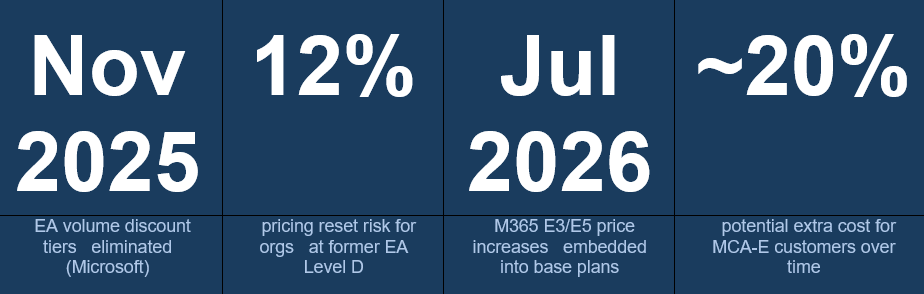
Microsoft eliminated these tiers from November 1, 2025. All organisations now pay Level A pricing, which matches the public list price. A company previously at Level D could have been receiving up to a 12% discount. It now pays what a much smaller organisation pays. The automatic reward for volume is gone.
This change hits EA customers hardest at renewal. Organisations expecting their established pricing to hold may find their renewal quote considerably higher than anticipated, before any product price increases are factored in.
On top of this, Microsoft has announced price increases for M365 E3 and E5 effective July 2026. These reflect Microsoft embedding Copilot features into the base plans, whether organisations use them or not. EA customers currently under contract are protected by price lock. Those renewing after mid-2026 or on MCA-E are not.
3. Enterprise Agreement: Stability, but at What Cost?
The EA’s core value has always been price certainty. You negotiate, you lock in, you know what you will pay for three years. That certainty remains real, but the context around it has shifted.
With volume tiers gone, the EA no longer delivers automatic scale discounts. What you now get from an EA is price protection against future increases, not a discount for size.
That protection is valuable if you are approaching renewal before a price increase lands. An EA signed before July 2026 locks out the E3 and E5 increases for three years. For larger organisations, that is potentially meaningful budget protection.
The trade-offs are familiar. EA requires volume commitment upfront. True-up adjustments apply annually for seats added during the term. Reducing seats mid-term is not straightforward. The EA suits organisations with stable, predictable seat counts, typically 2,400 or more, and procurement processes that favour long-term certainty over flexibility.
“An EA signed before July 2026 locks out the price increase for three years. Timing your renewal is not optional planning. It is financial management.”
4. CSP: Partner-Led and More Flexible Than You Think
The CSP model routes licensing through an accredited Microsoft partner. At face value, this adds a cost layer: the partner takes a margin. In practice, the picture is more nuanced.
CSP allows organisations to lock in current rates for up to three years through the partner, avoiding the July 2026 price increases. There is no minimum seat count, making CSP accessible to smaller organisations that do not qualify for EA. Partners frequently bundle support services, migrations, or deployment resources, which has real value if your internal IT capacity is limited.
For organisations managing Microsoft 365 through a managed service provider, CSP is often the most natural route. The partner handles licensing, support, and optimisation as part of a single relationship.
The risk is partner dependency. Pricing quality varies. An inexperienced partner may not optimise your licence mix actively. Governance visibility, what is assigned, what is being used, what could be right-sized, often depends on what the partner provides. For IT teams that want direct governance oversight, CSP can feel opaque without the right tooling alongside it.
5. MCA-E: Microsoft’s Direction of Travel
Microsoft is pushing enterprises toward MCA-E. From March 2026, Microsoft began migrating EA customers on Microsoft Azure Consumption Commitment plans to MCA-E. The direction is clear: the EA is becoming legacy infrastructure for many organisations.
MCA-E suits organisations that want maximum flexibility. There is no fixed seat commitment, billing adjusts monthly or annually as usage changes, and subscribing to a new product does not require a contract renegotiation.
The downside is price exposure. MCA-E carries no price lock. When Microsoft raises prices, MCA-E customers absorb the increase immediately. Analysis suggests that over time, MCA-E customers face a potential cost increase of approximately 20% relative to what a negotiated EA would have delivered. For larger organisations, that gap is significant.
MCA-E works best for cloud-first organisations with unpredictable seat counts, or for initial Microsoft 365 adoption where flexibility matters more than cost optimisation. It is not the right model for organisations that prioritise budget predictability.
Renewal Timing Risk
If your EA renewal falls in 2026 and you have not evaluated your options yet, time is running short. Organisations renewing before July 2026 can still lock in current E3 and E5 pricing for three years. Those who renew after that date, or move to MCA-E without negotiating a price lock, will absorb the full increase. This is a financial decision with a deadline.
6. How to Choose
No single model is right for every organisation. The decision depends on five factors:
Size: EA favours 2,400 or more seats. Below that, CSP is often more practical. MCA-E works at any scale but gives up price protection.
Seat stability: If your headcount is predictable, commit to volume. If it fluctuates significantly, flexibility has real value.
Renewal timing: With July 2026 increases confirmed, the window to lock in pre-increase pricing through an EA or CSP three-year deal is closing.
Partner relationship: If you manage Microsoft 365 through an MSP or CSP partner, route the licensing through them. If you manage it directly, EA or MCA-E is more appropriate.
Governance maturity: Whichever model you choose, you need visibility into what you are actually using. Right-sizing before renewal reduces the cost baseline you are committing to.
That last point is the one most organisations overlook. Signing a three-year EA on an over-sized licence count locks in the waste. Before committing to volume, know exactly what you are consuming.
Conclusion
Microsoft’s licensing structure is simpler than it used to be, but more consequential at the margins. The elimination of EA volume tiers and the July 2026 price increases have made agreement selection a financial decision, not just a procurement one.
The EA still offers the best price protection for large, stable organisations, particularly those renewing before mid-2026. CSP remains the right model for partner-managed environments and smaller organisations. MCA-E works for cloud-first organisations that value agility over certainty.
What no model removes is the need for clean licence data before you sign. The fastest way to overpay on a three-year commitment is to commit to more licences than you are actually using. That is a visibility problem, and it can be resolved before you sit down with Microsoft.
Organisations that enter renewal negotiations knowing their actual consumption, their unused licences, and their growth trajectory make better decisions. Those that do not sign whatever Microsoft puts in front of them.
About TeamsFox
TeamsFox is a Microsoft 365 management and optimisation platform trusted by organisations in 20+ countries across Europe, MENA, and Asia. Headquartered in Erkrather Str. 401, 40231 Dusseldorf, Germany, TeamsFox gives IT teams real-time, file-level visibility across licence consumption, storage, and governance. Before your next Microsoft renewal, TeamsFox shows you exactly what you are using, what you are not, and what a right-sized commitment looks like.