Agents are multiplying faster than the rules that govern them. Establishing an AI agent governance framework is essential before that gap becomes your incident report.
September 2026 | 7 min read
At a Glance
1. Why 2027 Is the Deadline That Matters
AI agent governance stopped being a future problem some time in 2026. Microsoft shipped Agent 365 into general availability on 1 May 2026 as a dedicated control plane, with per-seat pricing at $15 per user per month. AvePoint got there earlier with AgentPulse. Copilot Studio, Azure AI Foundry, and Copilot Cowork are all producing agents that hold identities, consume budget, and touch data. The tooling now exists. The habits mostly do not.
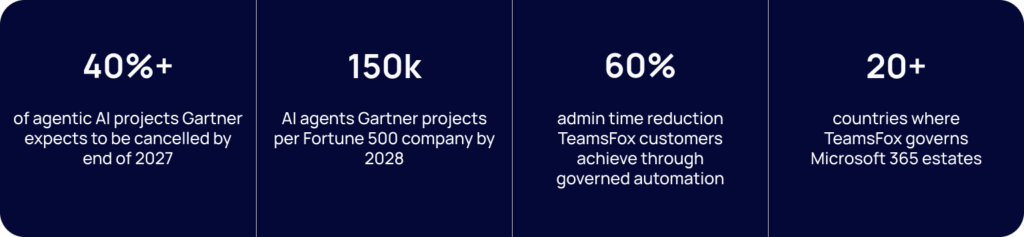
The cost of that gap has a number attached. Gartner predicts more than 40% of agentic AI projects will be cancelled by the end of 2027, citing escalating costs, unclear business value, and inadequate risk controls. The same firm projects around 150,000 agents per Fortune 500 company by 2028. Read those two figures together: the volume is coming regardless, and the projects that die will be the ungoverned ones. 2027 is the year the survivors get separated from the cancellations. The AI agent governance framework you build in the next two quarters decides which side you are on.
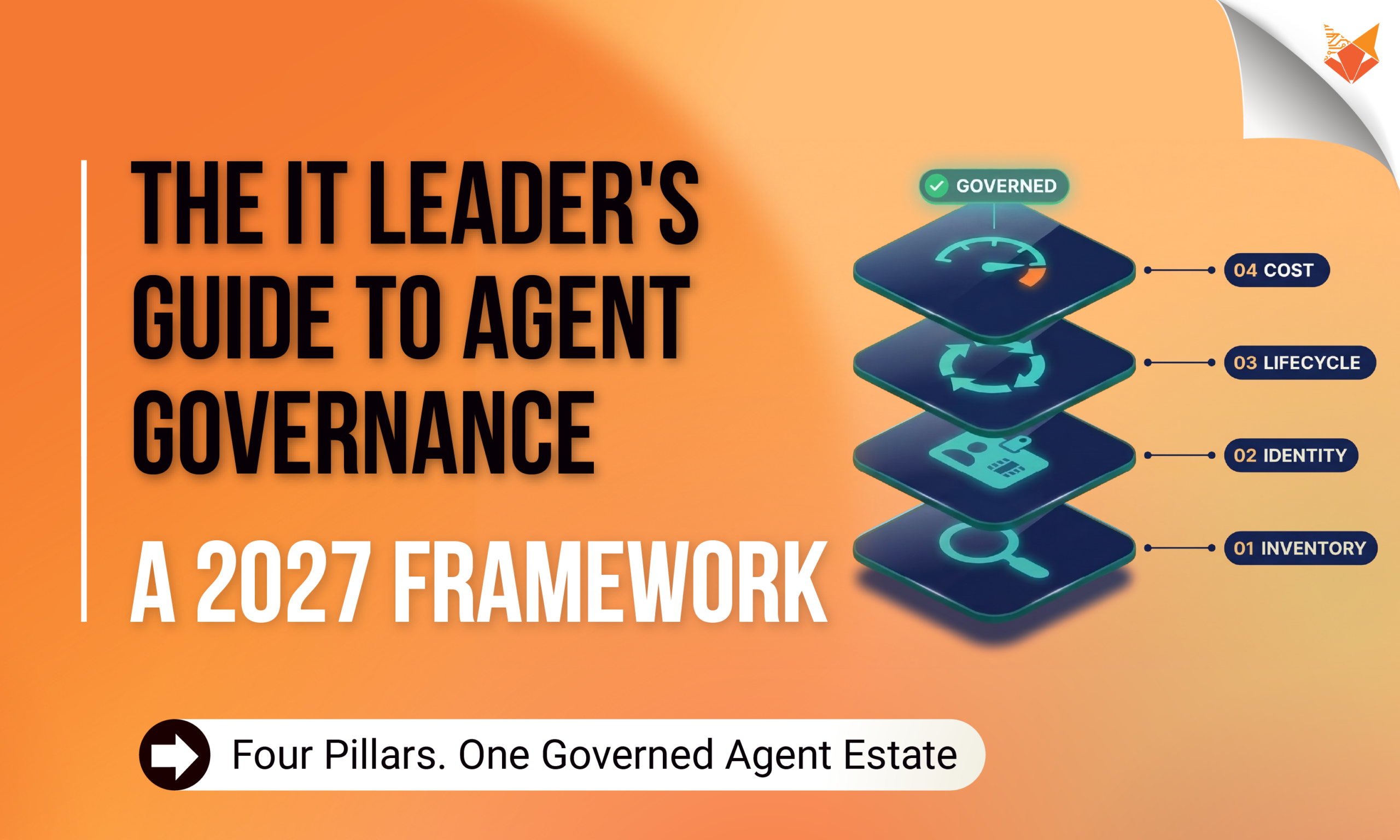
This article lays out that framework in four pillars: inventory, identity, lifecycle, and cost. None of it requires new technology categories. All of it requires discipline you may already have, applied to a new kind of identity.
2. Pillar One: Inventory. You Cannot Govern What You Cannot See
Every governance failure starts with an inventory failure. Microsoft reported that 80% of Fortune 500 companies were already running active AI agents in February 2026, yet very few IT teams can answer the first question of governance: how many agents exist in our tenant, who built them, and what can they reach?
The Power Platform taught this lesson a decade ago. Citizen-built apps and flows multiplied until IT discovered thousands of unmanaged artefacts, then spent years retrofitting environments, DLP policies, and ownership records. Agent sprawl is that story again, at higher speed and with more autonomy per artefact. Agent 365 now provides a Registry for discovering and inventorying agents, which is a real step. But a registry you do not actively review is a list, not a control. Set a cadence: full agent inventory review, monthly, with named owners for every entry.
An agent you do not know about is not a productivity gain. It is an unaudited account with initiative.
3. Pillar Two: Identity. Separate What an Agent Can Do From What It Can Reach
Gartner made an underrated point in May 2026: applying uniform governance across all AI agents leads to failure. The distinction that matters is between an agent’s ability to act and the scope of access it is granted. A high-autonomy agent with narrow access is manageable. A low-autonomy agent with tenant-wide read access is a breach waiting for a prompt.
Microsoft’s answer is Entra Agent ID: agents become first-class identities, with scoped permissions, sponsors, and entitlement management through access packages. That is the right architecture, and it is also exactly the discipline of least privilege that service accounts were always supposed to get and rarely did. Treat every agent like a service account with a language model attached. Grant the minimum, review quarterly, and never let an agent inherit its creator’s permissions wholesale. Permissions hygiene is the same muscle whether the identity is a person, a service principal, or an agent, and it sits at the heart of Microsoft 365 governance as a practice.
Risk: the ownerless agent. Agents outlive their creators. Employees leave, projects end, and the agent keeps running with the permissions it was given, invisible to routine review. Gartner expects 40% of enterprises to demote or decommission agents on post-incident governance gaps by 2027. Every agent needs a named human sponsor, and an agent whose sponsor leaves should be suspended by default, not by exception.
4. Pillar Three: Lifecycle. Every Agent Needs an Owner and an Expiry Date
Licences taught IT the ghost problem: accounts and assignments that persist after the human need has gone. Agents have ghosts too, and they are worse, because a ghost agent still acts. Agent 365 supports rules-based lifecycle management, expiring inactive agents, flagging ownerless ones, and blocking risky ones. Use those controls, but recognise that the policy has to come from you: what counts as inactive, who approves creation, what a decommissioning checklist contains, and how long agent audit logs are retained.
A workable minimum lifecycle policy fits on one page:
- Creation: every agent gets a named sponsor, a stated purpose, and a scoped access package before it runs in production.
- Review: quarterly recertification of purpose and permissions, exactly as you would recertify privileged human access.
- Inactivity: agents idle for 60 days are suspended automatically; sponsors get 30 days to justify reactivation.
- Decommissioning: access revoked, identity disabled, audit trail retained, sponsor sign-off recorded.
None of this is exotic. It is lifecycle management, the discipline that already stops organisations paying for departed employees’ licences, pointed at a new identity type.
5. Pillar Four: Cost. Four Meters, One Budget
Agent economics are now genuinely complicated. Agent 365 governance is per-seat. Copilot Studio and Azure AI Foundry execution is consumption-based. Copilot Cowork added a fourth meter at its June 2026 GA, pricing on model, context, tool calls, and runtime. Gartner’s cancellation prediction leans hard on this: organisations that budgeted for pilot-scale inference are discovering production costs several times higher than projected, and unclear value plus runaway cost is how projects die.
Cost governance for agents is therefore not an accounting afterthought. It is a survival criterion. The practice looks familiar: continuous consumption monitoring, per-agent cost attribution, budget thresholds with alerts, and regular right-sizing of what runs. This is licence management logic extended to metered execution: an agent is a licence to right-size, an identity to govern, and a consumption stream to monitor.
6. What Microsoft Covers, and What Stays Your Job
Microsoft now sells real agent governance infrastructure: the Agent 365 Registry, Entra Agent ID, Purview auditing, Defender runtime protection. AvePoint sells a dedicated governance product. Neither sells the thing that actually determines outcomes: your policies, your review cadence, your ownership model, and your willingness to switch off what nobody can justify. Controls without habits are shelfware.
To be direct about our own position: TeamsFox does not sell a dedicated agent-governance product. What we bring is the governance discipline this framework describes, proven on the problems that agents now replay: licence sprawl, permissions drift, ghost accounts, and invisible consumption. Our existing capabilities in visibility, permissions hygiene, lifecycle management, and cost control extend to agent identities because agents are, structurally, the same governance problem. The framework above is tool-agnostic. The habits are not optional.
FAQ: Building an AI Agent Governance Framework
What is AI agent governance?
AI agent governance is the set of controls and habits that keep autonomous AI agents inventoried, identity-scoped, lifecycle-managed, and cost-controlled: knowing what agents exist, what they can access, who owns them, and what they consume.
Does Microsoft Agent 365 solve agent governance?
Agent 365 provides the infrastructure: a registry, identity via Entra Agent ID, auditing, and lifecycle rules. It does not provide the policies, ownership model, or review cadence. Those remain the organisation’s job, and they determine whether the controls deliver.
How many AI agents will enterprises run by 2028?
Gartner projects around 150,000 agents per Fortune 500 company by 2028, up from early pilots today. Microsoft reported 80% of Fortune 500 companies were already running active agents in February 2026.
How do you stop AI agent sprawl?
The same way Power Platform sprawl was contained: continuous inventory, named ownership for every artefact, least-privilege access, automatic suspension of inactive agents, and cost attribution per agent. Governance habits, applied early, before the volume arrives.
Conclusion
The agent wave is not speculative any more. The platforms are GA, the pricing meters are running, and the analysts have already priced in a 40% failure rate. What separates the cancelled projects from the compounding ones will not be model quality. It will be governance: boring, repeatable, unglamorous governance.
The encouraging news is that nothing in the four-pillar framework is new. Inventory, identity, lifecycle, and cost are the same disciplines that tamed licence sprawl, permissions drift, and shadow IT. Organisations that already run those muscles have a head start; organisations that never built them are about to pay for the omission at agent speed.
Start small and start now. One inventory review. One sponsor per agent. One suspension rule for inactivity. One monthly cost report. Each habit is modest on its own, and together they are the difference between an agent estate you run and one that runs you.
The organisations building these governance habits today will be the ones in control when agents become standard infrastructure. The rest will be writing incident reports about identities they did not know they had.
About TeamsFox
TeamsFox is a Franco-German Microsoft 365 management and optimisation platform headquartered at Erkrather Str. 401, 40233 Düsseldorf, Germany. Customers in more than 20 countries across Europe, MENA, and Asia use TeamsFox to cut licence costs by 30%, reduce admin time by 60%, and lower storage spend by 40%. Learn more at www.teamsfox.com.